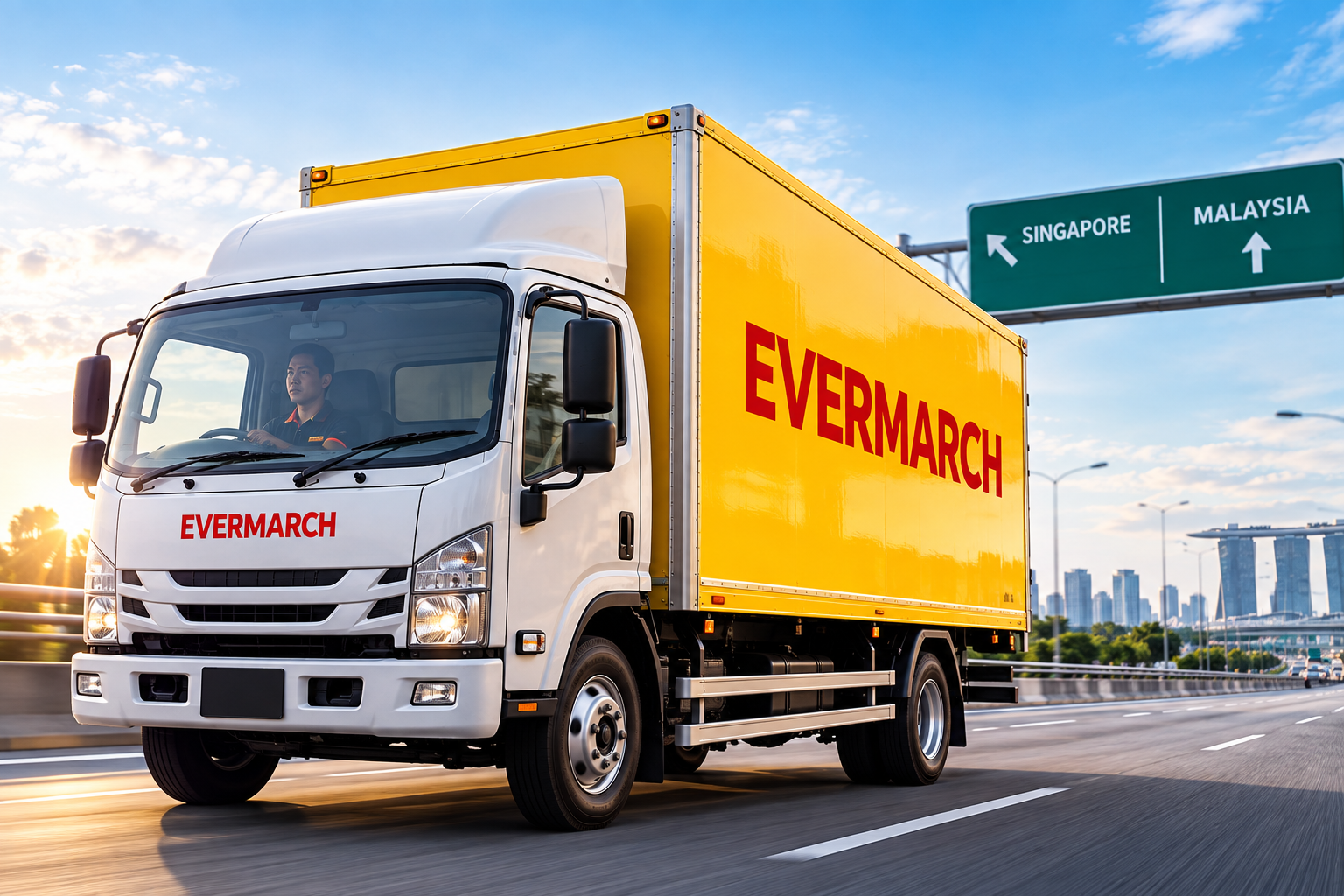
Reliable cross border haulage solutions
We deliver dependable cross-border trucking services across international corridors. Count on us for safe handling, seamless customs compliance, and timely distribution.
If your business needs cross border trucking services Singapore to Malaysia, speak with Evermarch today. Give the team your cargo details, collection point, destination and delivery requirements, and let Evermarch build a practical transportation solution around your operation. Don’t just move cargo from warehouse to warehouse—build a stronger Singapore-Malaysia supply chain with Evermarch as the logistics partner behind every important shipment.
Our freight haulage services
From partial shipments to dedicated full truckloads, we offer versatile road freight operations designed to keep cross-border supply chains moving without delay.

Full truckload freight
Dedicated point-to-point transport for large shipments across international frontiers, ensuring maximum security and direct route timing.

Less than truckload
Cost-effective consolidated transit for palletised cargo, giving businesses flexible distribution without paying for unused trailer space.

Temperature-controlled transit
Chilled and frozen haulage options equipped with real-time temperature tracking for perishable goods and sensitive pharmaceutical supplies.

Customs and border transit
Complete documentation management and customs clearance assistance to prevent costly hold-ups and ensure strict regulatory adherence.
"Cross border simplified our regional haulage overnight. Their border handling and punctuality have given our distribution network total peace of mind."
From Warehouse to Warehouse How Cross Border Trucking Singapore Keeps Cargo Moving
A cargo shipment does not become successful simply because a truck leaves the warehouse on time. The real test comes later: does the cargo cross the border properly, arrive at the right Malaysian destination, and reach the receiving team in a condition and timeframe that supports the business?
For Singapore companies moving goods across the border regularly, cross border trucking Singapore is therefore much more than a vehicle booking. It is a connected logistics journey that starts at the warehouse, continues through transportation and border procedures, and ends only when the cargo reaches the receiving location.
The Journey Starts Before the Truck Arrives
One of the easiest mistakes businesses make is thinking that logistics begins when the driver reaches the pickup point.
In reality, good transportation planning starts earlier. The cargo needs to be ready, shipment details should be confirmed, loading arrangements need to be understood and the relevant documentation should be prepared before collection.
This preparation gives cross border trucking services a better chance of running according to plan because the transportation provider is working with actual shipment information rather than last-minute assumptions.
Warehouse Preparation Can Make or Break a Shipment
A truck can arrive exactly when requested and still end up waiting if the cargo is not ready.
Perhaps the goods are still being packed. Maybe the warehouse team is handling another delivery. The loading bay may also be occupied or the cargo may be stored somewhere that makes collection difficult.
For recurring Singapore-Malaysia shipments, businesses should establish a clear warehouse collection routine. This can include a standard cargo-ready time, loading instructions, warehouse contact person and any site-access requirements.
A few minutes of planning before collection can save much more time during the actual transportation process.
Know Exactly What You Are Sending
A logistics provider cannot plan around cargo information that does not exist.
The shipment description should give a clear idea of what is being transported. Quantity, weight, dimensions and packaging details are equally important, especially when the cargo is heavy, bulky or unusually shaped.
For Singapore to Malaysia cross border trucking, businesses should provide accurate information before the transportation arrangement is confirmed. If the actual shipment differs significantly from the original information, the planned vehicle or handling arrangement may no longer be suitable.
Why Weight and Dimensions Matter
Two shipments can contain the same number of boxes but require very different transportation arrangements.
One may consist of lightweight cartons, while the other may contain dense industrial components. Similarly, a pallet that fits comfortably into a vehicle is very different from long materials or oversized machinery.
This is why weight and dimensions should not be treated as minor technical details. They help determine whether the transportation arrangement is appropriate for the actual cargo.
Cross Border Trucking Is Not Just About Distance
Singapore and Malaysia are geographically close, but cross-border cargo still involves international trade procedures.
The truck has to move through the relevant border process, and the shipment must meet the applicable customs and documentation requirements.
Singapore Customs provides procedures covering import and export permits, supporting documents and customs clearance requirements for applicable goods. Businesses should check the requirements relevant to their particular shipment instead of assuming that every cargo movement follows exactly the same process.
This is one reason cross border trucking services Singapore businesses use should include proper shipment planning rather than treating border clearance as an afterthought.
Documents Need to Match the Cargo
Good documentation is not about having more paperwork. It is about having the right information and ensuring that it accurately represents the shipment.
Commercial invoices, packing lists, customs permits and other supporting documents may be required depending on the transaction and goods involved.
If the physical cargo says one thing while the documents describe something significantly different, the mismatch can create questions and additional work.
For businesses moving cargo regularly, maintaining a consistent documentation process can make each shipment easier to prepare.
The Border Is Only One Part of the Journey
Businesses sometimes focus heavily on getting cargo through the border and forget that the shipment still has to reach the final destination.
Once the cargo continues into Malaysia, the receiving warehouse, factory, customer or project site still needs to be ready.
The delivery address should be accurate, the receiving party should know what is coming and the site should be able to accommodate the delivery.
A successful cross-border shipment is therefore not complete at the checkpoint. The real destination is the customer's receiving location.
What Happens When the Malaysian Warehouse Is Not Ready?
Imagine the truck arrives, but the receiving warehouse has closed for the day.
The cargo may now need to wait, the delivery schedule may change and the operations team may need to coordinate another arrangement.
This is why delivery instructions should include more than an address. Businesses should communicate receiving hours, site access, contact details and unloading requirements where relevant.
For cross border trucking Singapore to Malaysia, these final-mile details can be just as important as the transportation plan itself.
Different Cargo Needs Different Planning
Not all business cargo should be treated the same way.
General Commercial Cargo
Cartons, pallets and regular stock may be relatively straightforward to transport when the cargo is properly prepared and the transportation arrangement is suitable.
The focus is usually on accurate information, proper packing and clear collection and delivery instructions.
Industrial Equipment
Machinery and industrial equipment can require additional attention because of their weight, dimensions and loading requirements.
Businesses should discuss these shipments early so the logistics provider can assess the transportation requirements before collection.
Project Cargo
Construction and factory-related projects can involve large or irregular cargo that needs to arrive according to a project schedule.
For these shipments, transportation planning should consider not only the cargo but also site access, unloading and the sequence in which the equipment or materials will be needed.
When Cargo Consolidation Makes Sense
Not every business shipment requires a dedicated truck.
If a company has a smaller quantity of cargo, consolidation may provide another transportation option where the shipment is compatible with other cargo and the delivery timing works.
This can be useful for businesses that regularly move smaller quantities between Singapore and Malaysia but do not always have enough cargo for a full vehicle.
However, consolidation should be evaluated according to the business requirement. If the shipment is time-sensitive, the most important consideration may be the delivery schedule rather than simply the available capacity.
Dedicated Trucking Has Its Place Too
For larger shipments, specific delivery requirements or certain types of commercial cargo, dedicated transportation may be more suitable.
A dedicated vehicle can provide a more direct transportation arrangement and may make sense when the cargo fills a significant portion of the available capacity or requires particular handling.
The decision should be based on shipment characteristics, not a blanket assumption that one transportation method is always better.
Recurring Cargo Should Have a Repeatable Process
If your company ships from Singapore to Malaysia every week, there is little value in treating every shipment like the first one.
The operations team should ideally have a repeatable process covering cargo preparation, documentation, collection, transportation and delivery.
The logistics provider can also become familiar with common routes, cargo profiles and destination requirements.
This makes it easier to manage regular cross border trucking services while still allowing the arrangement to change when the shipment itself changes.
Communication Is the Glue Holding the Journey Together
A truck cannot solve a communication problem.
If the warehouse does not know when the cargo will be collected, the cargo may not be ready. If the Malaysian receiving team does not know when the truck is expected, unloading may become difficult.
Clear communication between the shipper, logistics provider and receiving party helps everyone understand what is happening and what needs to happen next.
For recurring cargo movements, a clear point of contact can make the process significantly easier for everyone involved.
What Should You Tell Your Cross Border Trucking Provider?
Before requesting a transportation arrangement, prepare the information that matters.
Cargo Information
Describe the goods, quantity, weight, dimensions and packaging.
Pickup Information
Provide the complete collection address, warehouse operating hours and loading requirements.
Destination Information
Provide the Malaysian delivery address, receiving contact and any site-access restrictions.
Timing
State when the cargo will be ready and when the receiving party needs it.
Special Requirements
Highlight oversized items, machinery, unusual dimensions or specific loading and unloading conditions.
This information allows the logistics provider to build the transportation arrangement around the shipment instead of making assumptions.
Why Experience Matters in Singapore-Malaysia Road Freight
Cross-border transportation involves many practical details that become easier to recognise through experience.
A logistics provider that regularly handles Singapore-Malaysia cargo is more familiar with the types of information businesses need to prepare and the operational questions that should be asked before a shipment moves.
That does not eliminate every possible delay because border, traffic and operational conditions can change. What it can provide is a more structured approach to preparing and coordinating the shipment.
How Evermarch Supports Cross Border Cargo Movements
Evermarch provides cargo transportation between Singapore and Malaysia, supporting businesses with cross-border delivery as well as logistics services such as cargo consolidation, warehousing and distribution.
Its service offering also covers different cargo requirements, including commercial shipments and specialised or project-related cargo.
For businesses, this means the conversation can begin with the actual logistics requirement instead of simply asking whether a truck is available.
A Better Way to Think About Cross Border Trucking
The best way to understand cross border trucking Singapore is to stop thinking of it as one isolated movement.
It is a chain of connected steps: prepare the cargo, organise the collection, manage the transportation, complete the required border procedures and coordinate the final delivery.
When these steps are planned together, businesses have a clearer process and fewer unnecessary handovers to manage.
Frequently Asked Questions About Cross Border Trucking Singapore
What is cross border trucking?
Cross border trucking is the transportation of goods by road between two countries. For Singapore businesses, it commonly involves commercial cargo moving between Singapore and Malaysia.
What are cross border trucking services Singapore?
These services provide road transportation for cargo crossing the Singapore-Malaysia border and may include collection, delivery, consolidation and related logistics coordination depending on the provider.
What cargo can be transported from Singapore to Malaysia?
The suitable cargo depends on the goods, transportation requirements and applicable regulations. Common business shipments include cartons, pallets, industrial components, equipment and project cargo.
What should I prepare before booking cross border trucking?
Prepare the cargo description, quantity, weight, dimensions, pickup location, Malaysian destination, delivery timing and relevant documentation.
Can small shipments be consolidated?
Potentially. Cargo consolidation can be suitable for compatible smaller shipments when the route and delivery schedule meet the business requirements.
Can oversized equipment be moved across the border?
Depending on the cargo specifications and transportation requirements, oversized equipment can be transported with suitable planning for vehicle capacity, loading and unloading.
How can businesses reduce unnecessary logistics problems?
Start with accurate cargo information, prepare documentation early, communicate clear collection and delivery requirements and work with a logistics provider that understands Singapore-Malaysia transportation.
Move Cargo From Warehouse to Warehouse With Less Logistics Friction
Cross-border transportation should not end with your team wondering where the cargo is, whether the documents are ready or whether the receiving warehouse can accept the delivery. The whole journey matters—from your Singapore warehouse to the final Malaysian destination.
If your business needs cross border trucking services Singapore to Malaysia, speak with Evermarch today. Give the team your cargo details, collection point, destination and delivery requirements, and let Evermarch build a practical transportation solution around your operation. Don’t just move cargo from warehouse to warehouse—build a stronger Singapore-Malaysia supply chain with Evermarch as the logistics partner behind every important shipment.
Keep your cargo moving seamlessly
Whether handling urgent cross-border deliveries or ongoing freight operations, our modern fleet and experienced drivers deliver results you can rely on every single mile.
Frequently asked questions
Everything you need to know about our international road freight, border clearance procedures, and scheduling options.

Contact our team
Cross Border Freight Depot
Logistics Way
London E16 2BS
Operations hours
Mon - Fri: 7:00am - 7:00pm
Saturday: 8:00am - 4:00pm
Sunday: 24-hour emergency dispatch
Direct enquiries
Follow us